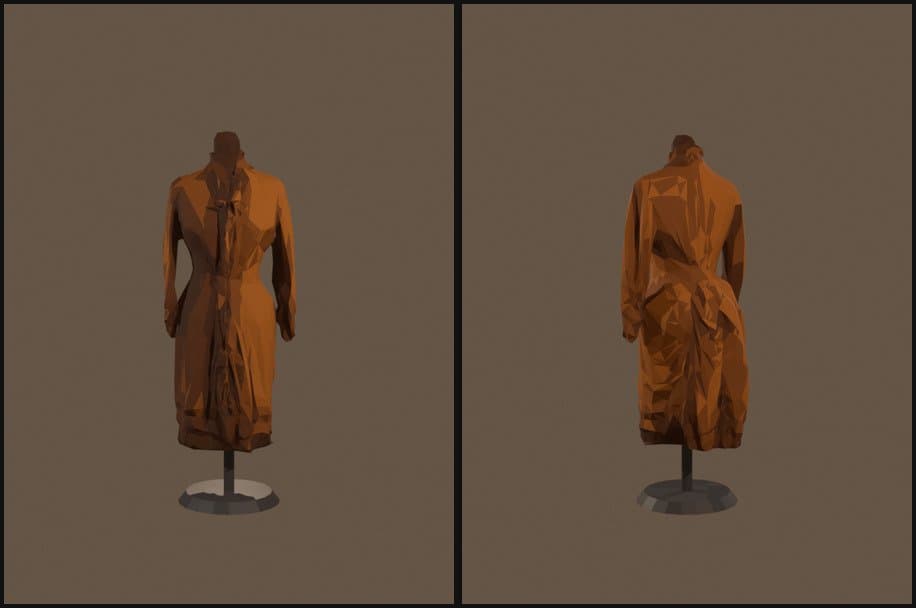
3D Garment Capture — Research Pipeline
3 garments, fully processed end to end — capture, mesh, geometric features, clustering
- Context
- grew out of the Historic Fashion Archive RA role; the Archive is the pilot dataset
- Pipeline
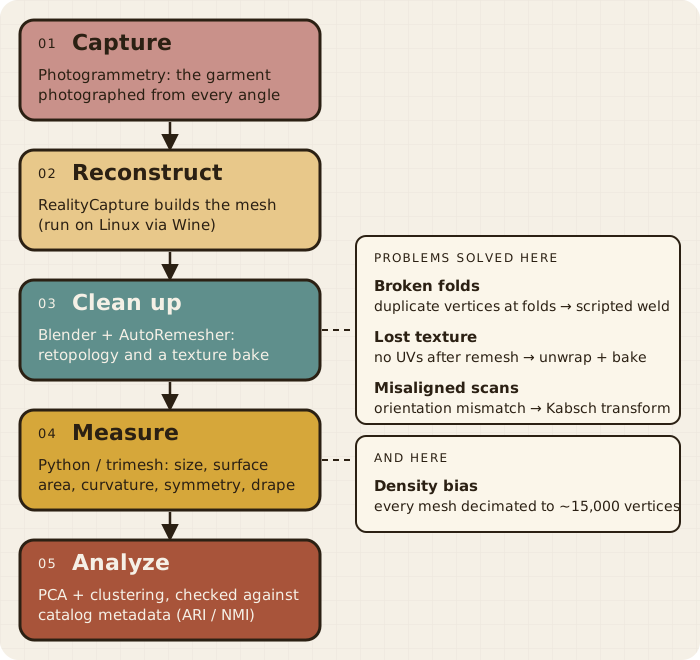
- physical photogrammetry capture → mesh reconstruction (RealityCapture, run on Linux via Wine) → mesh cleanup/retopology (Blender, AutoRemesher) → feature extraction (Python/trimesh: bounding box, surface area, volume, curvature, symmetry, drape) → PCA + clustering, validated against catalog metadata via ARI/NMI
- Broken folds
- coincident duplicate vertices at fabric folds broke retopology; fixed with a scripted vertex weld
- Lost texture
- AutoRemesher output has no UV coordinates; a Blender UV-unwrap + Cycles bake carries the real photo texture onto the clean mesh
- Misaligned scans
- exports disagreed on orientation; fixed with an exact Kabsch-algorithm transform
- Density bias
- mesh density was confounding the extracted features; every mesh is decimated to ~15,000 vertices before measurement
- Pilot results
- 3 real garments processed end-to-end (capture → mesh → features → PCA/clustering), with six geometric features per garment, including symmetry and drape
- Current stage
- pilot — PCA/clustering sanity checks on real data, before any supervised ML
- Repo
garment-capture-pipeline(first commit 2026-09-06)
The problem
The main question we were trying to answer was: how can we give people access to a higher degree of interaction with garments in the collection without risking damage to the physical items? The solution came in the form of capturing garments in 3D with photogrammetry. With a 3D mesh, people can freely move through a 3-dimensional space, examining a garment from any angle — something a fixed 2D photo and a text catalog entry can't give you. That opens the door to things the Archive couldn't do before: comparing silhouettes directly, getting a real sense of drape, and eventually querying the collection by shape instead of just by catalog tags.
What I'm proudest of
What I'm proudest of is how much new technology and software I had to learn with no prior experience — photogrammetry, mesh processing in Blender, feature extraction in Python, unsupervised clustering — and that the project keeps evolving rather than staying a fixed capture pipeline, now folding in genuinely novel work like the PCA/clustering analysis and the path toward supervised machine learning. It's also the project most directly tied to my coursework as both a statistician and a computer scientist, which makes it feel less like a side project and more like where those two tracks actually meet.
What's next
More gates open the more data we generate. I expect the machine learning side to keep taking root — the proposed next step is a supervised proof-of-concept predicting curator-assigned silhouette labels directly from geometry, which would be the first real test of whether these extracted features carry the signal a curator actually cares about. Beyond that, scaling from 3 garments to a larger pilot set (15–20) is what would make the PCA/clustering results trustworthy rather than suggestive.